

If you are wondering how to study in Canada from Malaysia, the first step is understanding the expected costs and visa requirements before applying.
Canada offers students a multicultural study environment, recognised institutions, practical learning options, and wider international exposure and the possibility of planning for work experience after graduation.
A realistic student budget should include tuition fees, living expenses, visa-related fees, insurance, flights, books and arrival costs.
This guide breaks down what students should know before applying to study in Canada, so you can plan your next step with more confidence.
The cost to Study in Canada should be reviewed as a full first-year budget. Use the table below as a planning guide, then confirm the latest amount with the university or college before paying any deposit.
| Cost item | Estimated amount in CAD | Notes for students |
|---|---|---|
| College diploma tuition | CAD 16,000 - 25,000/year | Check co-op and progression options. |
| University undergraduate tuition | Starting price: CAD 41,746/year | Professional programmes may cost more. |
| University graduate tuition | Starting price: CAD 24,028/year | Research and professional fees vary. |
| Living expenses proof | Minimum CAD 22,895/year outside Quebec | Excludes tuition and transport. |
| Study permit fee | CAD 150 | Paid to IRCC when applying. |
| Biometrics fee | CAD 85 per individual | Check IRCC instructions. |
| Books and supplies | CAD 1,000 - 2,500/year | Higher for lab/design/computing programmes. |
| Flights and arrival costs | Varies | Include winter clothing and housing deposit. |
Contact us to discuss your study in Canada plans and get personalised guidance on the next step.

When planning to study in Canada, avoid looking at tuition fees alone. Malaysian families should also prepare for:
If affordability is a key concern, do not choose a university based only on ranking or city popularity. A suitable programme in a lower-cost province may offer a better balance between education quality, student experience and long-term financial comfort.

Students usually need a Canadian study permit for post-secondary study in Canada. A study permit is the immigration document that allows eligible international students to study at a Designated Learning Institution (DLI).
Before applying, students should prepare these key items:
In most cases, your study permit application starts after receiving your Letter of Acceptance.
Post-secondary students should also check whether a PAL or TAL is required, as this is often arranged through the institution before the visa application can move forward.
Find out more about the Canada study visa requirements to ensure it doesn’t delay your application before intake starts.
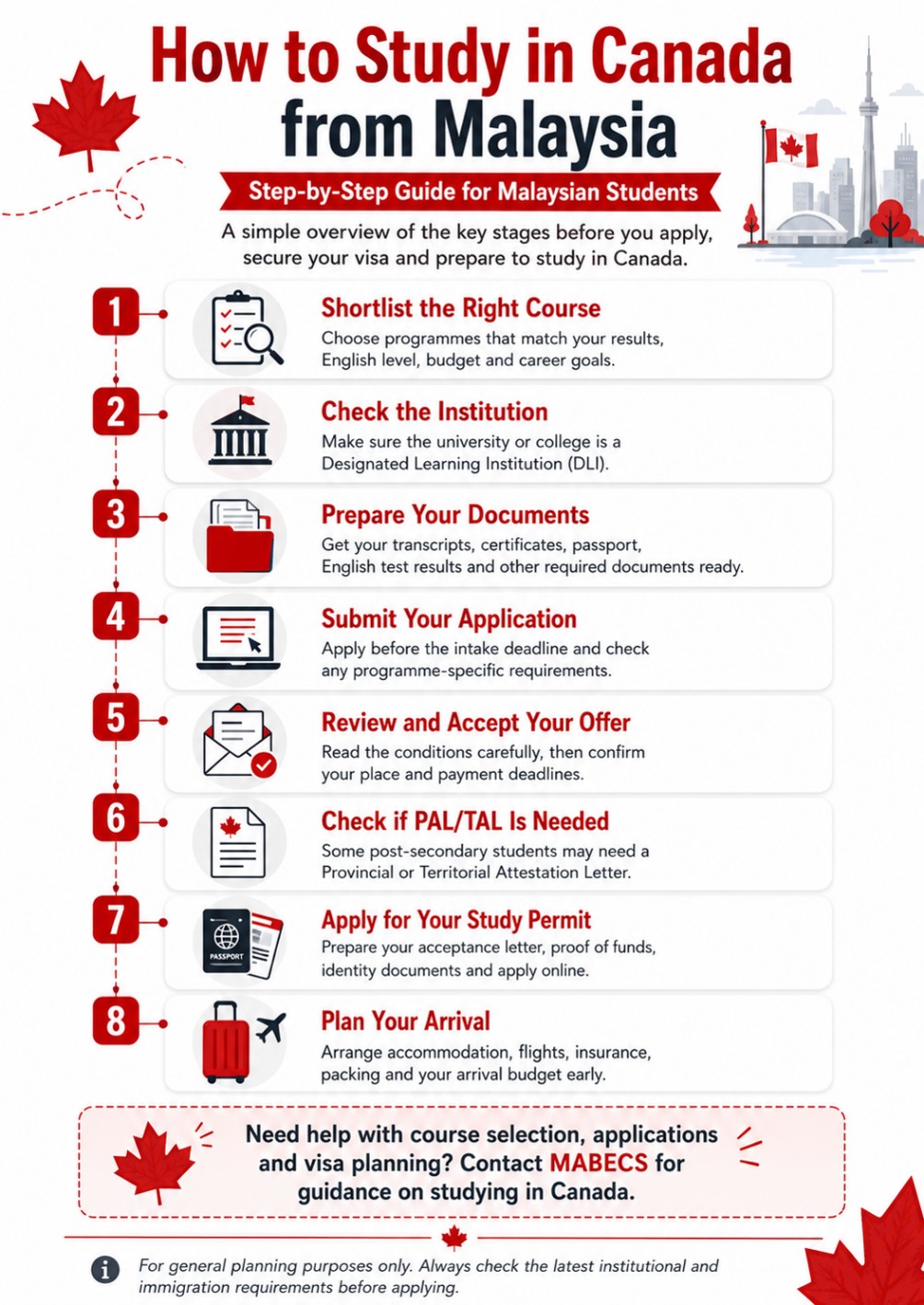
Students can make the Canada application process less stressful by planning each stage early, including course selection, admission documents and study permit preparation.
Contact our MABECS advisors today to discuss your study in Canada plans and get personalised guidance on choosing the right course, preparing your application and planning your next step.
Eligible students may work off campus only after their programme has started. IRCC states that eligible students can work up to 24 hours per week during regular terms and unlimited hours during scheduled breaks, provided they meet study permit conditions. Students also need a Social Insurance Number before working.
Part-time work can help with experience and daily expenses, but it should not be treated as the main way to fund your studies. Your study permit application must show that you can support yourself without relying on future income in Canada.

Education advisors at MABECS helps students make clearer decisions for studying abroad in Canada by turning scattered information into a practical application plan.
Our education advisors can help you understand which study options are realistic, what documents you need to prepare, and which deadlines should be prioritised before you apply.
This support is especially helpful if you are unsure about:
Students do not have to manage the process alone through guided support.
You can receive guidance on course selection, university and scholarship application preparation, enrolment steps and study permit planning, so your Canada study journey feels more organised and less stressful.
Studying in Canada is a big decision, and the best pathway is not always the most obvious one. Your course choice, tuition budget, entry requirements, intake timeline and visa preparation all need to work together before you apply.
If you are still comparing Canadian universities or colleges, MABECS can help you move from uncertainty to a clearer plan. Our Education Advisors will guide you in reviewing your academic goals, identifying suitable study options and understanding the key steps needed for your application.
Getting the right guidance early can help you avoid missed deadlines, unsuitable course choices and last-minute document stress.
Contact the MABECS team today to discuss your study in Canada plans and take the next step towards your Canada study enrollment.
One student outside Quebec currently needs at least CAD 22,895 for living expenses, excluding tuition and transportation.
Yes, most students need a Canadian study permit before starting post-secondary study in Canada.
A PAL or TAL is a provincial or territorial attestation letter that may be required before submitting a Canada study permit application.
Eligible international students can work up to 24 hours per week off campus during regular terms and unlimited hours during scheduled breaks.
Yes, MABECS guides students with course shortlisting, application planning, enrolment steps and visa-document preparation for Canada study pathways.