

Writing a scholarship application can feel intimidating, especially when many other students may also have strong grades, leadership roles and co-curricular achievements.
However, scholarship panels are not searching for a “perfect” student. They want applicants who can explain their goals clearly, show evidence of potential and connect their story to the purpose of the scholarship.
This guide explains how to write scholarship application materials that actually get noticed, from planning your personal statement to preparing supporting documents.
Most weak scholarship applications fail for the same reason: they sound too general. Students often repeat phrases such as “I am passionate”, “I am hardworking” or “I want to achieve my dreams” without showing proof.
These statements may be true, but they do not help the reader understand what makes you different.
Another common issue is using one personal statement for every scholarship. Scholarship providers may have different priorities.
Some focus on academic excellence, some on leadership, some on financial need, some on social impact and some on a specific course or industry.
Your application should respond to the scholarship’s exact criteria, not just describe your life story.
Contact an education advisor at MABECS for personalised guidance on scholarship applications and about suitable UK study options, available scholarships and how to prepare a more focused application.

Before drafting anything, read the scholarship page carefully. Check the eligibility requirements, study level, field of study, deadline, award value, required documents and whether a separate application is needed.
Some scholarships are automatically considered after you apply to a university, while others require essays, portfolios, interviews or additional forms.
This step is important because scholarship options can vary depending on nationality, academic results, chosen country, institution and intake.
Create a simple checklist for each scholarship so you do not miss a deadline or submit the wrong document.
A scholarship application becomes stronger when it is supported by evidence.
Before writing, list your academic results, awards, leadership roles, volunteering activities, work experience, competitions, family responsibilities, personal challenges and career goals. Then match each item to a quality the scholarship panel may value.
For example, instead of saying you have leadership skills, explain that you led a school club committee, managed a team of volunteers or coordinated a fundraising activity. Describe a real challenge and what you did to overcome it.
Specific examples make your application more credible.
A good scholarship essay does not need to be complicated. It needs to be easy to follow. Use a clear beginning, middle and ending so the reader can understand your motivation, evidence and future plan.
| Scholarship Essay Section | What to Include |
|---|---|
| Introduction | Open with your course goal, motivation or a short meaningful story. Make it relevant to the scholarship. |
| Body Paragraph 1 | Show academic strengths, skills or achievements with evidence. |
| Body Paragraph 2 | Explain leadership, community involvement, work experience or personal growth. |
| Body Paragraph 3 | Connect the scholarship to your study plans, financial need or future contribution. |
| Conclusion | End with confidence, gratitude and a clear statement of how you will use the opportunity. |
This structure helps you avoid jumping between unrelated points. It also makes your writing easier to review and edit.
To write a scholarship application that stands out, show that you understand what the scholarship is trying to support.
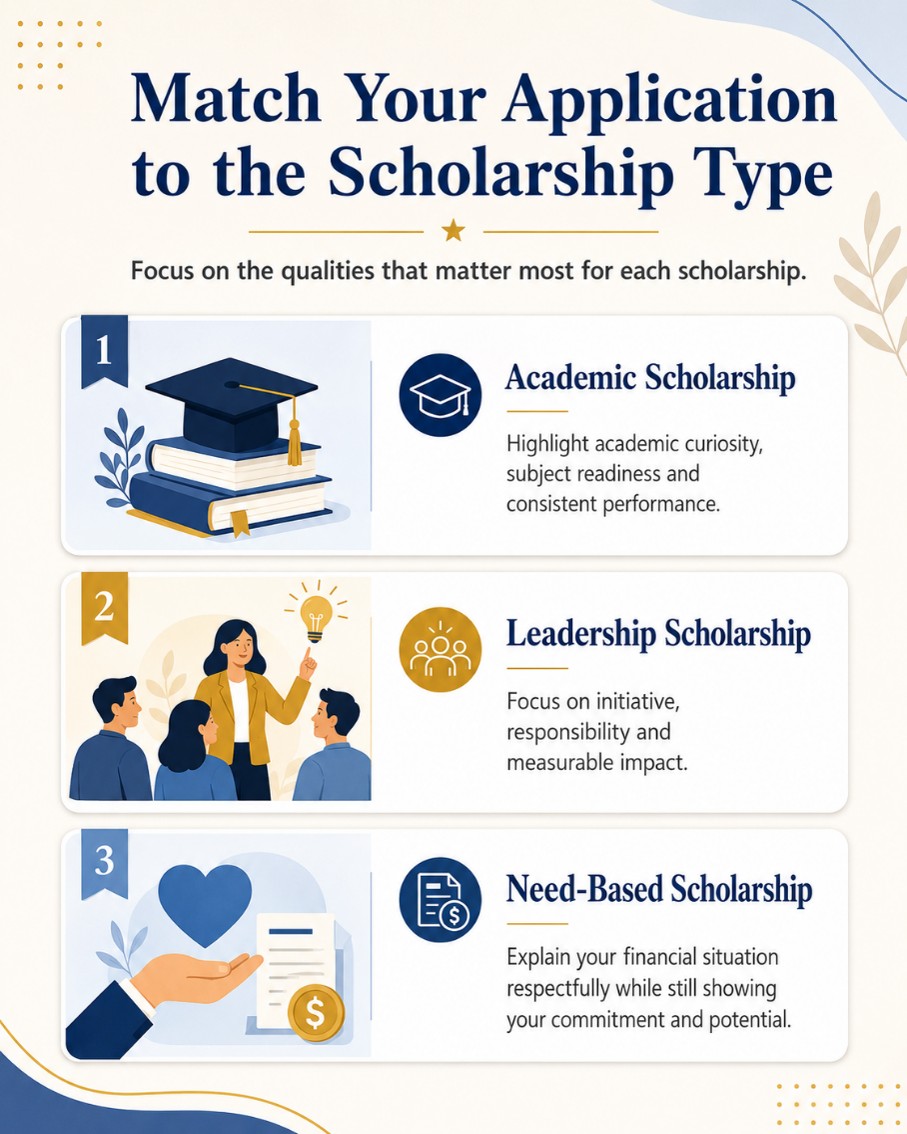
Tailoring does not mean pretending to be someone you are not. It means choosing the most relevant parts of your story for each opportunity.
Speak with MABECS to explore suitable scholarship opportunities and get clearer guidance on how to prepare a stronger application before the next intake.

Scholarship panels want to know that you have thought seriously about your next step.
Explain why you are applying for a particular course, how it fits your strengths and what you hope to do after graduation.
Students applying overseas should also mention why that country, university or academic environment supports their goals.
Avoid vague goals such as “I want to be successful”. A stronger version would explain the field you hope to enter, the problem you want to solve and the skills you need to build. This makes your scholarship application feel purposeful rather than generic.
Find out more about the foundation courses in the UK for international students if you are considering getting a Malaysia scholarship to study in the UK.
Many students worry about sounding arrogant when writing about achievements. The key is to present facts calmly. Use evidence, not exaggeration.
You can say what you achieved, what you learned and how others benefited from your actions.
For example, instead of writing “I am the best candidate for this scholarship”, you could write, “My academic record, leadership experience and commitment to community service have prepared me to make full use of this scholarship opportunity.” This sounds confident, but still professional.

A scholarship application may need academic transcripts, forecast results, reference letters, certificates, a CV, proof of income, offer letters or passport details. Some documents take time to request, especially recommendation letters from teachers, lecturers or employers.
Ask your referees early and give them helpful context: the scholarship name, your course, your achievements and the submission deadline.
A strong reference letter should support the same qualities you are highlighting in your essay.
After writing your first draft, do not submit it immediately. Read the scholarship criteria again and check whether every paragraph answers the brief.
Remove repeated ideas, vague claims and sentences that do not add value. Then proofread for grammar, spelling, flow and tone.
A useful editing test is to ask: “Could another student write this exact sentence?” If the answer is yes, make it more specific to your experience.
Scholarship applications are memorable when they sound personal, focused and honest.
Next step is to learn how to apply for scholarship in Malaysia, including submission of documents to the scholarship panels.

MABECS study abroad agency gives students a clearer application plan by reviewing your study goals, academic background, preferred UK universities and scholarship options.
Our experienced education advisors can advise you on eligibility requirements, student scholarship opportunities linked to your chosen course or university, and the application materials needed to present your strengths more clearly.
This guidance can also reduce common mistakes, such as applying for unsuitable scholarships, missing separate application requirements or submitting a personal statement that feels too general.
We can support your next steps so your course selection, university application and scholarship strategy work together.
Knowing how to write scholarship application materials is only the beginning. To improve your chances, your application needs to be focused, complete and tailored to the scholarship you are applying for.
MABECS guides you in exploring suitable scholarship opportunities, reviews your application direction and shares personalised guidance based on students’ journey and career path.
Speak with MABECS advisors to make your scholarship application stronger, clearer and better prepared before submission.
Include your study goals, achievements, leadership or community experience, financial need if relevant, and how the scholarship will help you contribute in the future.
Follow the stated word limit exactly; if no limit is given, keep it focused, structured and detailed enough to answer the prompt clearly.
No. You can reuse your core story, but each scholarship application should be tailored to the provider’s criteria, values and requirements.