

Planning to study in New Zealand is exciting, but the visa stage can feel confusing when you are trying to balance offer letters, bank statements, tuition fees, accommodation and deadlines.
Understanding the New Zealand student visa requirements early can make the whole process less stressful and help you avoid delays before your intake.
This guide explains the main requirements, estimated visa cost and New Zealand study costs you should prepare for before applying.
Yes. If you plan to study in New Zealand for more than three months, you generally need a student visa.
The most common option for international students is the Fee Paying Student Visa, which allows students to study full-time with an approved education provider. The visa may be granted for the same period as the study you have paid for, up to a maximum of four years.
Different visitor visa or NZeTA rules may apply for short courses of three months or less.
However, students planning a diploma, bachelor’s degree, postgraduate diploma, master’s degree or English language course should prepare for a proper student visa application.
In Australia and New Zealand, when you get your visa letter, you will often see your university be labelled as a provider, which is short for education provider.
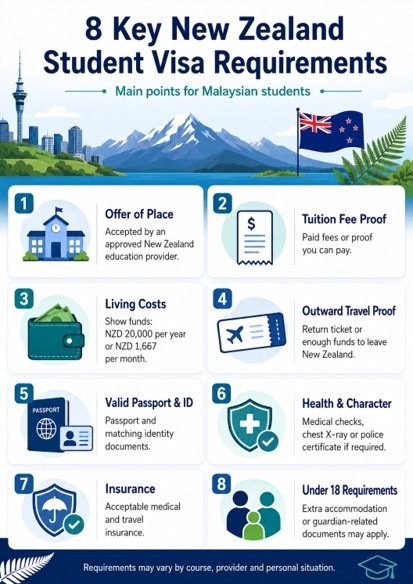
The exact documents can vary depending on your course, provider, background and personal situation, but most students should prepare the following:
You need an official offer of place from a New Zealand education provider. This confirms that you have been accepted into a programme and gives Immigration New Zealand the course details needed to assess your application.
You must show that you have enough money to pay your tuition fees, or that your tuition is covered by a scholarship, sponsor, loan or other acceptable funding arrangement. Keep your payment receipts and offer documents organised because unclear fee evidence can slow down the process.
For tertiary education, English language or other non-compulsory study, students must show at least NZD 20,000 for each year of study, or NZD 1,667 for each month if the programme is shorter than one year. This is separate from tuition fees and outward travel costs.
You need to prove that you can leave New Zealand at the end of your stay. This can be shown through a paid ticket out of New Zealand or enough additional funds to purchase one.
Your passport should be valid for the period required by Immigration New Zealand and ideally beyond your planned stay. Make sure your personal details match across your passport, offer letter, academic records and visa forms.
Depending on your length of stay and background, you may be asked for medical checks, chest X-ray results or police certificates. Complete these ahead of time through approved channels and avoid waiting until the last minute.
International students are normally required to have acceptable medical and travel insurance while studying in New Zealand. Your provider may guide you on approved insurance options.
Students under 18 may need extra accommodation confirmation from their education provider. Younger students may also have guardian-related requirements, so parents must check this early if the student is not yet an adult.

The Fee Paying Student Visa currently starts from NZD 850. This is the visa application cost and does not include every possible expense you may need during preparation.
You should also budget for medical examinations, X-rays, police certificates, document translations, insurance, tuition fee deposits, accommodation deposits and currency exchange differences.
These costs vary depending on your situation, so it is safer to prepare a buffer instead of budgeting only for the visa fee.
Student visa applications are submitted online. Immigration New Zealand no longer accepts paper applications for this visa type, so students should scan documents clearly and check that all files are complete before submission.
New Zealand study costs depend on your university, course, city and lifestyle. As a general planning guide, many international students should prepare for the following cost areas:
| Cost Area | Estimated Budget / Notes |
|---|---|
| Tuition fees | Often around NZD 20,000 to NZD 55,000 per year depending on programme, level and provider. |
| Living funds for visa | At least NZD 20,000 per year for tertiary or English language study, or NZD 1,667 per month for shorter study. |
| Accommodation | Shared housing can start from about NZD 140 per week, while catered halls may cost more. |
| Food and groceries | A basic grocery budget may be around NZD 80 to NZD 120 per week, depending on location and lifestyle. |
| Transport, phone and internet | Public transport, mobile plans and shared internet should be added to your monthly budget. |
| Insurance and study materials | Costs vary by provider and course; include textbooks, equipment, software and health/travel cover. |
Because these are estimates, it is important to check your university’s latest fee schedule and compare the cost of living in cities such as Auckland, Wellington, Christchurch, Dunedin or Hamilton before making a final decision.
Start your New Zealand study plan with MABECS and get clearer guidance on courses, costs, documents and application timelines.
The safest approach is to start preparing once you receive your offer of place and to apply around three months before your intended travel date where possible.
Immigration New Zealand notes that students should allow enough time for processing, especially during busy intake periods.
For students targeting February or July intakes, this means your course application, financial planning and document preparation should begin much earlier than the visa submission date.
Waiting until the offer arrives before checking your financial evidence can create unnecessary pressure.
Many eligible student visa holders may work part-time up to 25 hours per week during study periods and full-time during scheduled holidays, depending on visa conditions. This can help with daily expenses and work experience, but it should not be treated as the main way to prove affordability.
Your visa conditions will state exactly what you are allowed to do. Always follow those conditions carefully, because breaching work rules can affect future visa applications.
Speak to a MABECS advisor to explore suitable New Zealand study options and get guided support for your overseas education journey.
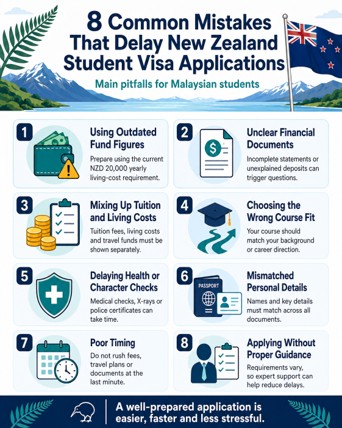
Even when students meet the basic New Zealand student visa requirements, small mistakes can delay the process. Students should avoid the above common issues.

MABECS study abroad agency helps you narrow the options based on your qualifications, preferred study pathway, budget and long-term plans.
We assist you in comparing the practical differences, such as course structure, entry expectations, tuition range, living costs and future study or career considerations. This helps you make a decision that is not just popular, but suitable for your situation.
Once you are ready to apply, MABECS supports the enrolment journey by helping you organise key application steps, understand offer conditions, prepare supporting documents, review scholarship application possibilities and stay aware of visa preparation requirements.
Students will be able to avoid confusion, reduce delays and move forward with a more confident study plan.
Preparing for getting the New Zealand student visa is easier when you have a clear study plan from the beginning. Every step matters in applying for your ideal course, managing costs, and document preparation for university and visa application before your intake gets too close.
Let MABECS guide you in exploring suitable universities, understanding your study options, planning your enrolment steps and preparing for the student visa process.
Contact MABECS today to start planning your New Zealand study journey and avoid unnecessary delays before your next intake.
Students usually need an offer of place, tuition and living-cost proof, outward travel funds, insurance, identity documents, and any required health or character evidence.
For tertiary or English language study, prepare at least NZD 20,000 per year for living costs, excluding tuition fees and outward travel funds.
The Fee Paying Student Visa currently starts from NZD 850, before extra costs such as medical checks, translations, insurance or document preparation.
Eligible students may work up to 25 hours per week during study periods and full-time during scheduled holidays, subject to visa conditions.
MABECS recommends preparing early and applying around three months before travel where possible, so documents, funds and enrolment steps are not rushed.
Yes, MABECS supports students with course shortlisting, institution comparison, application planning, enrolment guidance and student visa preparation reminders.