

UK Intakes refer to the periods when universities welcome new students and begin courses.
Most students will see three intake windows: September or October, January or February, and May or June. However, not every university or course is available in every intake.
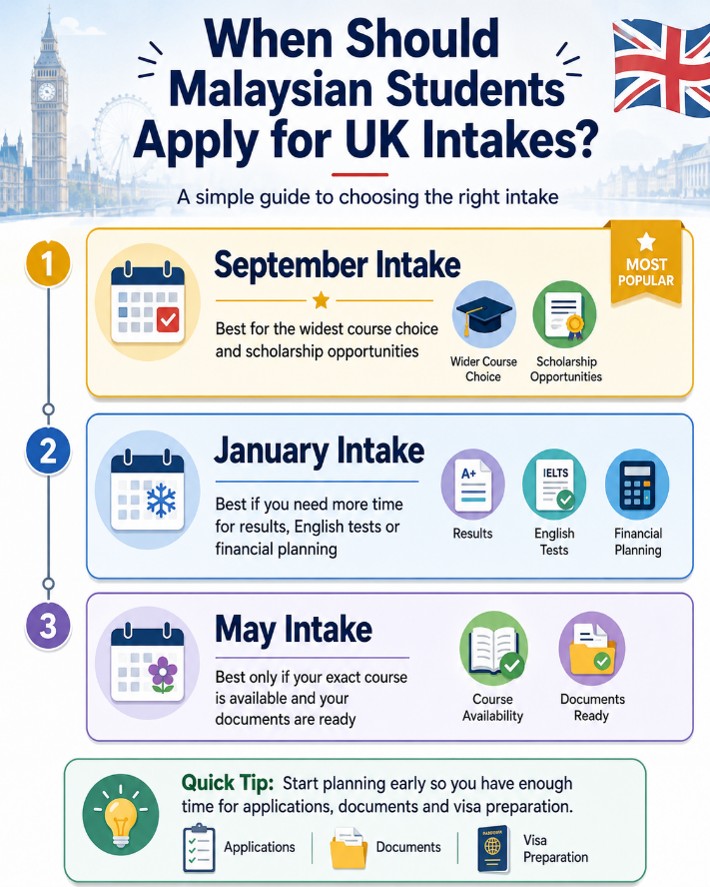
As a general rule, September is the main UK intake with the widest range of courses, scholarships and accommodation options. January is a useful second intake for students who need more time to prepare. May is more limited and usually applies to selected pathway, top-up or postgraduate programmes.
The intake you choose can affect your application deadline, course availability, scholarship timing, CAS issuance, visa planning and travel arrangements.
The better question is: which intake gives you the best course options and enough time to apply properly?
| UK intake | Best for | Apply around | Key note |
|---|---|---|---|
| September/October | Most undergraduate and postgraduate students | 12-18 months before start | Widest choice of courses and scholarships |
| January/February | Students needing more preparation time | 6-9 months before start | Good second option, but fewer courses |
| May/June | Selected pathway, top-up and PG routes | 4-6 months before start | Limited availability; check carefully |

The September or October intake is the main intake for UK universities. It is usually the best choice for students who want the widest selection of undergraduate and postgraduate courses, stronger scholarship availability and more time to arrange accommodation.
If you are applying for competitive courses such as Medicine, Dentistry, Veterinary Science, Law, Architecture or high-demand Russell Group programmes, September is often the most realistic intake to target.
For 2027 undergraduate entry, UCAS says completed applications can be submitted from 1 September 2026. The equal consideration deadline is 15 October 2026 for Oxford, Cambridge, Medicine, Dentistry and Veterinary Medicine or Science, and 13 January 2027 for most other undergraduate courses.
Students aiming for September intake should ideally start planning 12 to 18 months before the course begins.
Find out why study in the UK attracts students to submit their applications for these intakes.
The January or February intake is a strong alternative for students who missed September deadlines, need more time after results, want to improve English test scores, or are considering postgraduate study.
Many January options are postgraduate taught courses such as business, finance, marketing, engineering management, computing and data-related programmes.
The main trade-off is course availability. January does not always offer the same undergraduate range or scholarship options as September.
Students should research from April to June of the previous year and apply by August to October where possible, depending on the university deadline.
The May or June intake is the smallest UK intake. It can work for students applying to selected pathway courses, top-up degrees or specific postgraduate programmes.
However, May should be treated as a niche option, not a default plan. If your preferred university or course is not open in May, waiting for September may be better than choosing a less suitable course.
Check out the foundation courses in the UK for international students to determine which intake to enrol to.
Speak to MABECS today to get personalised guidance on the right UK intake, university shortlist, UCAS application and student visa preparation.
Your best intake depends on when your results and documents will be ready. SPM, IGCSE, STPM, UEC, A-Level, AUSMAT, CIMP, IB, diploma and degree students may all need different timelines.
Postgraduate applicants may also need academic transcripts, references, a statement of purpose and work experience documents.
Start early if scholarships matter, because many awards close before general admission deadlines.

After choosing your preferred UK intake, the next step is knowing how and when to apply.
Most undergraduate students apply through UCAS, while postgraduate, foundation and pathway applications are usually submitted directly to universities or providers.
Because deadlines vary by course, university and intake, students should prepare early for offers, documents, CAS and visa guidance.
MABECS guides students through the right application route, key deadlines and enrolment steps with greater confidence.
Speak to MABECS about your UK study plans and get personalised guidance on choosing the right intake, shortlisting suitable universities and preparing your application.
Since 1985, MABECS education advisors has worked closely with students planning to study in the UK.
We provide support for study in the UK for Malaysians across university shortlisting, UCAS submissions, entry requirement checks, offer conditions, enrolment preparation, application for scholarship to study in the UK, and visa-related guidance.
The team is also British Council and BUILA trained, giving students access to informed advice throughout the application process.
For September, January or May intake planning, students can speak to MABECS to compare realistic options, prepare stronger applications and move forward with better confidence.
UK Intakes give students flexibility, but the right intake should match your course, results, scholarship needs and visa readiness. September gives the strongest overall choice, January offers a valuable second opportunity, and May works only for selected programmes.
Contact our higher education experts at MABECS about your UK study plans. We can help you choose the right intake, shortlist suitable universities and prepare your application with confidence.
Most UK universities offer three main intakes: September/October, January/February and limited May/June options.
September is usually the best UK intake for students because it offers the widest course selection, scholarship access and accommodation options.
Students should ideally start planning 12 to 18 months before September intake, especially for UCAS, competitive courses and scholarship deadlines.
Yes, January intake can suit students who need more time for final results, English tests, finances or postgraduate applications.
No, May intake is limited and usually applies to selected pathway, top-up or postgraduate programmes, so course availability must be checked first.
No, January intake varies by university and course, which is why MABECS advises students to confirm options early before delaying their application.
No, MABECS can guide students using predicted or current results so they can shortlist universities, understand requirements and prepare earlier.